Tokenization feasibility, without hype
TVAC helps you decide whether tokenization is actually worth it. It evaluates if a specific tokenization design creates net added value compared to a conventional structure â and delivers a solid, case-specific deep report (typically 30+ pages, ~9,000 words) with the full rationale, assumptions, risk focus, and concrete next steps.
TVAC helps you decide whether tokenization is actually worth it â in minutes, not months. You get a structured report that makes costs, risks, and value transparent before you spend time and money.
Guided tour
Instead of a fragile âmini-evaluationâ widget, this is a visual, step-by-step tour through a concrete tokenization case report â showing the structure, the five-factor logic, the assumptions, and how the analysis becomes case-specific (not a generic LLM prompt response).
Who itâs for
For teams that must be credible, conservative, and execution-oriented â and need a repeatable way to qualify real projects.
Determine whether a specific tokenization project creates net added value â and what must be in place before proceeding.
Qualify inbound requests, clarify scope, and accelerate onboarding across legal, technical, and operational workstreams.
Use a consistent decision basis and comparable outputs across a tokenization pipeline â internally or when servicing clients.
The model
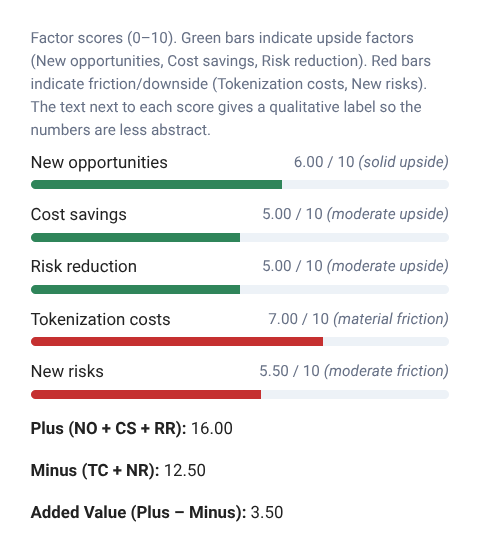
TVAC is a standardized assessment framework that makes tokenization cases comparable and explainable across types and asset classes. It uses a scoring manual with fixed criteria for each of the five components in the addedâvalue model: New Opportunities, Cost Savings, Risk Reduction, Tokenization Costs, and New Risks. The assessment is anchored in structured input parameters such as jurisdictions, investor scope, disclosure, custody, settlement, venue, and transfer restrictions â so results do not depend on ad hoc judgment, but on a consistent method where you can see exactly which design choices drive the outcome.
Under uncertainty, TVAC scores conservatively and makes assumptions explicit â so you can iterate and re-run variants.
How it works
Designed to be useful early â before heavy legal/vendor work begins â and structured so stakeholders can trust the logic.
Asset, jurisdictions, investor scope, liquidity plan, custody model, constraints, and objectives.
Scores the case on five factors and applies the formula: (NO + CS + RR) â (TC + NR).
A structured, case-specific report (30+ pages, ~9,000 words) with rationale, assumptions, blockers and levers.
Run variants and compare outputs. Save the strongest structure and re-run.
Behind the scenes
TVAC is not a âsingle prompt.â It is a structured workflow that validates inputs, applies a fixed methodology, and assembles a consistent, board-ready report layout.
Important: TVAC does not publish raw model output. The model is constrained by TVACâs methodology and required structure, and the results are checked and normalized before rendering.
Note: Please avoid submitting sensitive personal data or highly confidential details.
Product proof
TVAC produces structured output you can share internally: factor logic, explicit assumptions, risk focus, and clear next steps. Tap the screenshot to view the full report structure (Table of Contents).
Report structure (AâZ)
A navigable walkthrough: verdict, scores, sources, pathways, friction & roadmap.
Open full size â
Factor breakdown (why each score)
Ties scores to your case inputs. Shows what drives upside vs friction.
Open full size â
Risk heatmap
Shows where to focus mitigation first (highest impact Ă likelihood).
Open full size âTVAC is designed for fintech/legal/institutional environments where trust comes from structure and transparency.
Download the Methodology & Calibration PDF (v1.2).
If the download link fails due to filename differences, ensure the PDF exists as /tvac-methodology-v1.2.pdf in repo root.
Launch pricing
Choose the format that fits your workflow: one-off evaluation, structured scenario iteration, or subscription access.
Launch pricing. Early access pricing currently applies while TVAC is being rolled out commercially. Pricing may be adjusted as the platform evolves and additional capabilities are introduced.
One-off deep assessment report
A full, structured report: verdict, factor scores, rationale, blockers, levers, and practical next steps â typically 30+ pages (~9,000 words) depending on case complexity.
5-report scenario pack
âŹ350 per report â a meaningful discount versus five separate runs (âŹ2,475).
Designed for one project where you want to test multiple variants: change assumptions, investor scope, liquidity setup, jurisdictional mix, operating model, or other key parameters across up to five runs.
TVAC Pro (subscription)
For platforms, advisors and teams evaluating multiple cases monthly.
12-month Pro: âŹ325/month equivalent. 6-month Pro: âŹ400/month equivalent.
Enterprise pilot or integration? Email: michael@tvacai.com
Where TVAC fits
Before committing to legal structuring, vendor selection, technical scoping, or external advisory work, many teams first need a structured view of whether the tokenization case actually appears worth pursuing.
TVAC is designed exactly for that stage. In minutes, TVAC produces a structured, case-specific feasibility report with explicit assumptions, factor-by-factor logic, and a clear verdict.
This allows teams to identify weak cases early, refine stronger ones, and enter any later legal, technical, or consulting process better prepared.
TVAC is not a replacement for specialist advisors. It is a faster and more efficient first filter â ensuring deeper advisory work begins only when the case already appears structurally credible.
FAQ
Clear, neutral answersâso you can decide if TVAC fits your use case.
TVAC (Tokenization ValueâAdd Calculator) is an informational decisionâsupport tool. It helps you evaluate whether a specific tokenization design is likely to create net added value versus a conventional structureâand it produces a structured, shareable report.
TVAC helps you make tradeâoffs explicit earlyâbefore you spend significant time and money on structuring, legal work, vendor selection, or procurement.
You get a clear verdict, a factorâbyâfactor rationale, explicit assumptions, and concrete design levers you can use to improve feasibility and added value.
TVAC is useful if you are evaluating, designing, or reviewing a tokenization initiativeâas an asset owner/issuer, project team, investment team, legal/compliance function, or service provider.
It is especially helpful when multiple stakeholders need a shared, structured basis for discussion.
TVAC uses a consistent fiveâfactor model:
Added Value = (New Opportunities + Cost Savings + Risk Reduction) â (Tokenization Costs + New Risks)
Each factor is scored on a 0â10 scale using predefined criteria. TVAC also applies a stakeholder lens (at minimum: Asset Owner, Investor, Service Providers) to highlight who captures upside and who bears costs/risks.
The verdict is derived from the Added Value profile and the internal consistency of the design (jurisdictions, investor scope, custody, venue, settlement, disclosure, and operating model).
Typical outcomes include Go, Conditional Go, Borderline, or NoâGoâwith clear âconditions to proceedâ when relevant.
Typically: asset type, jurisdictions, investor scope, legal wrapper, custody and venue assumptions, settlement/cashâleg approach, distribution thesis, and key constraints.
TVAC also reports an input completeness score and lists missing fields and explicit assumptionsâso thin or contradictory inputs are treated more cautiously.
A Deep Assessment is a boardâready report (typically 30+ pages) that includes:
TVAC does not claim to know every final cost item with absolute precision. That level of detail usually only emerges later, after legal structuring, vendor selection, technical scoping, and implementation planning.
What TVAC does provide is a structured, methodology-based evaluation of whether a project appears likely to generate net added value given the information available. It assesses the case based on its core characteristics, likely opportunity profile, probable cost and risk drivers, and the overall logic of the proposed tokenization model.
In short, TVAC is a decision-support tool for evaluating feasibility and value creation under real-world uncertainty â not a substitute for final budgeting, legal advice, or underwriting.
Noânot in the sense of claiming a giant benchmark database built from the full budgets, invoices, and time sheets of a large number of completed projects.
TVAC is based on a fixed methodology, explicit scoring criteria, and accumulated domain understanding of how tokenization cases typically create opportunities, generate costs, and introduce new risks across different structures and asset types.
The goal is not to pretend that every future project can be priced with accounting-level precision in advance. The goal is to provide a disciplined, transparent, and case-specific feasibility assessment that helps users judge whether a project looks commercially and structurally credible before moving into deeper budgeting and implementation work.
TVAC is designed for consistency and defensibility: fixed factor definitions, calibrated scoring criteria, and transparent reasoning tied to your inputs.
It is also intentionally conservative: when a case sits between verdict bands, the more cautious interpretation is usually chosen.
No. TVAC provides informational decisionâsupport only. Jurisdictionâspecific matters must always be validated with qualified professionals.
You should avoid entering sensitive personal data or confidential commercial details. Use anonymised placeholders where possible, and share only what is necessary to evaluate structure and feasibility.
If you have strict procurement or dataâhandling requirements, treat TVAC as part of a governed workflow and apply your internal controls.
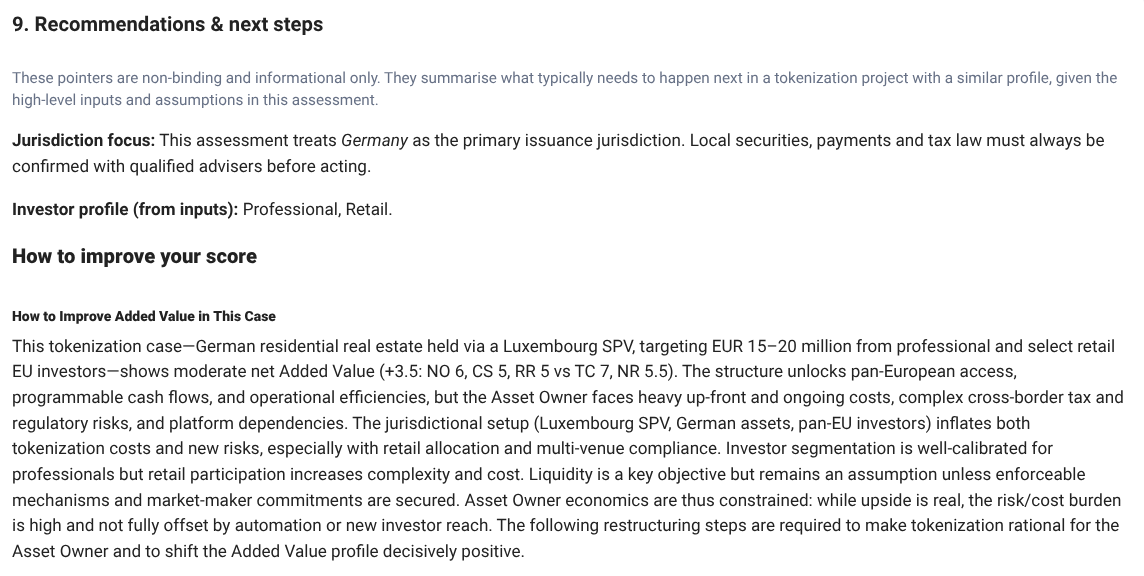
Yes. The report surfaces the few levers most likely to move the outcome: how to reduce costs/risks, tighten the operating model, and make distribution/liquidity assumptions more credible.
It also includes structured next steps and an indicative roadmap you can use for planning and stakeholder alignment.
About
TVAC is built by Michael Juul Rugaard â author of the book Asset Tokenization (2025) â as a practical evaluation engine for real tokenization decisions. Contact: michael@tvacai.com
Non-marketing technical note describing the five-factor model, verdict logic, calibration approach, and limitations.